Some useful competition notes!

I entered my latest thriller spec, FAR AS THE CROW FLIES in the Big Break competition – and because I haven’t had it in many competitions yet, I paid for feedback.

Competition feedback can be a mixed bag – but these ones had some gold in.

What I look for in competition notes is primarily to get an understanding of the impression a reader got from a fairly quick, potentially harried and interrupted read at the end of a long day. I suspect that’s pretty close to what a script read by an overworked intern often gets (except, presumably, they have the luxury of stopping when it’s clearly a pass).

For most competition read add-on fees, I don’t think it’s fair to expect more than that: readers aren’t being paid a fortune.

So when I get competition notes, I expect that things might get missed (it’s useful to know what gets missed). I expect that what I’ve done may simply not resonate with the reader. And sometimes, the part of the script that I think is its (hopefully) beating heart is not what my reader latches onto – and that can be fascinating.

What I hope for (besides the reader falling instantly in love with it and trumpeting its virtues from the rooftops), is information about where they got lost and what felt over-egged/unearned. And if I’m really lucky, something that makes me think ‘Ooh – that’s gold. I’m doing that – I’ve got to think about that’.

My Big Break notes were in the ‘ooh – there’s some useful nuggets in there’ category

Big Break organises their feedback into ‘Commendable qualities’ and ‘Revisions to Consider’ – which is nicely diplomatic.

Here’s what they liked.
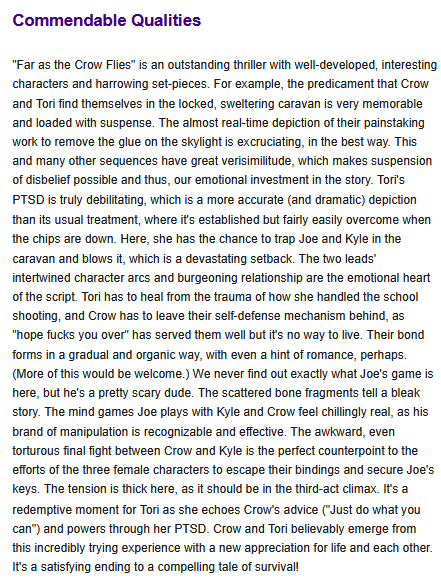
"Far as the Crow Flies" is an outstanding thriller with well-developed, interesting characters and harrowing set-pieces. For example, the predicament that Crow and Tori find themselves in the locked, sweltering caravan is very memorable and loaded with suspense. The almost real-time depiction of their painstaking work to remove the glue on the skylight is excruciating, in the best way. This and many other sequences have great verisimilitude, which makes suspension of disbelief possible and thus, our emotional investment in the story. Tori's PTSD is truly debilitating, which is a more accurate (and dramatic) depiction than its usual treatment, where it's established but fairly easily overcome when the chips are down. Here, she has the chance to trap Joe and Kyle in the caravan and blows it, which is a devastating setback. The two leads' intertwined character arcs and burgeoning relationship are the emotional heart of the script. Tori has to heal from the trauma of how she handled the school shooting, and Crow has to leave their self-defense mechanism behind, as "hope fucks you over" has served them well but it's no way to live. Their bond forms in a gradual and organic way, with even a hint of romance, perhaps. (More of this would be welcome.) We never find out exactly what Joe's game is here, but he's a pretty scary dude. The scattered bone fragments tell a bleak story. The mind games Joe plays with Kyle and Crow feel chillingly real, as his brand of manipulation is recognizable and effective. The awkward, even torturous final fight between Crow and Kyle is the perfect counterpoint to the efforts of the three female characters to escape their bindings and secure Joe's keys. The tension is thick here, as it should be in the third-act climax. It's a redemptive moment for Tori as she echoes Crow's advice ("Just do what you can") and powers through her PTSD. Crow and Tori believably emerge from this incredibly trying experience with a new appreciation for life and each other. It's a satisfying ending to a compelling tale of survival!

I’m pretty happy about this – keeping the tension high in the contained setting of the caravan was constantly on my mind as I wrote and rewrote this – as was having Crow and Tori’s emerging friendship feel real. And it feels like the reader stayed engaged throughout, which is really my first goal.

And here’s where they thought I’ve got more to do – and that’s where the little gold nuggets were as well as some food for thought.
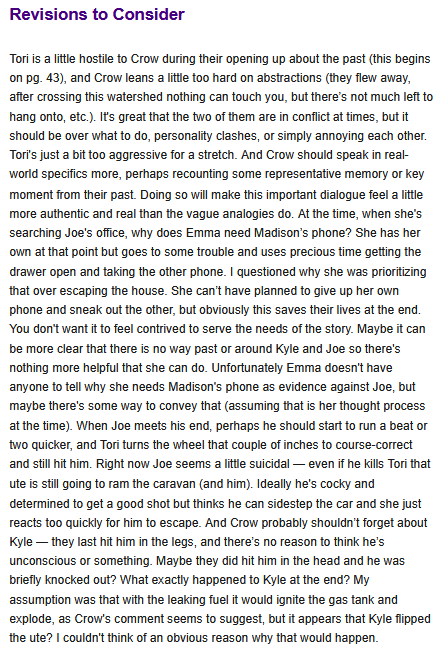
Tori is a little hostile to Crow during their opening up about the past (this begins on pg. 43), and Crow leans a little too hard on abstractions (they flew away, after crossing this watershed nothing can touch you, but there’s not much left to hang onto, etc.). It's great that the two of them are in conflict at times, but it should be over what to do, personality clashes, or simply annoying each other. Tori's just a bit too aggressive for a stretch. And Crow should speak in real-world specifics more, perhaps recounting some representative memory or key moment from their past. Doing so will make this important dialogue feel a little more authentic and real than the vague analogies do. At the time, when she's searching Joe's office, why does Emma need Madison’s phone? She has her own at that point but goes to some trouble and uses precious time getting the drawer open and taking the other phone. I questioned why she was prioritizing that over escaping the house. She can’t have planned to give up her own phone and sneak out the other, but obviously this saves their lives at the end. You don't want it to feel contrived to serve the needs of the story. Maybe it can be more clear that there is no way past or around Kyle and Joe so there's nothing more helpful that she can do. Unfortunately Emma doesn't have anyone to tell why she needs Madison's phone as evidence against Joe, but maybe there's some way to convey that (assuming that is her thought process at the time). When Joe meets his end, perhaps he should start to run a beat or two quicker, and Tori turns the wheel that couple of inches to course-correct and still hit him. Right now Joe seems a little suicidal — even if he kills Tori that ute is still going to ram the caravan (and him). Ideally he's cocky and determined to get a good shot but thinks he can sidestep the car and she just reacts too quickly for him to escape. And Crow probably shouldn’t forget about Kyle — they last hit him in the legs, and there’s no reason to think he’s unconscious or something. Maybe they did hit him in the head and he was briefly knocked out? What exactly happened to Kyle at the end? My assumption was that with the leaking fuel it would ignite the gas tank and explode, as Crow's comment seems to suggest, but it appears that Kyle flipped the ute? I couldn't think of an obvious reason why that would happen.

Taking them from the top:

I’m glad that none of the notes relate to the opening – they’re really all up around the mid-point or beyond. Being optimistic, that suggests the reader didn’t get lost in the setup.

The Tori hostility note is useful I think: by that point she’s more weary/exasperated than seriously hostile (though there’s probably a little bit of that), so some action line tweaks may do the trick.

The ‘vague Crow’ note needs some thought: I think it might be an over-egging problem rather than a vagueness problem. To me, what they say there is at the very core of the story I’m trying to tell and they are being specific – they’re talking about how events changed them, not the events themselves. But it’s clearly not quite landing for this (engaged) reader, so I’ll be looking again.

Madison’s phone… Dammit. They got me. Emma thinks the police won’t listen to her without proof (and they’re hours away anyway) – but it’s a moment I went back and forth on a bunch, wondering if I was wallpapering over a crack. Maybe a bit more setup for why Emma has that view. Definitely one I need to look at again.

The gold nugget is the suggestion about having Joe try to run and having Tori adjust course – that’s a sharp, easily implemented suggestion, which will make that scene better.

Fuel leaks don’t typically lead to gas tank explosions – but the Kyle note is a good one too, I was going for ‘ran out of fuel while driving down a steep slope’ – but maybe Kyle ran out of fuel and staggered off to die of thirst instead.

But I’m well pleased with these notes – regardless of what does or doesn’t happen with the competition, there’s enough here for me to wander off, do a bit more work and hopefully get some incremental improvements.

If you ever do run out of fuel in a vehicle in remote country, don’t leave the vehicle (unless you really really have no other option – i.e. encroaching fire). Vehicles are bigger and easier to find than people, so staying with it is generally your best bet.

And if FAR AS THE CROW FLIES sounds like it might be your cup of tea, you can request a read over at https://artofcharts.com/screenplays/

Leave a comment